

AfricaRice’s 34th Council of Ministers Charts a Bold Course for Africa’s Food Future
Abidjan played host to one of the most consequential gatherings in AfricaRice’s history. From 4 to 6 November 2026, ministers, scientists, national agricultural research leaders, and development partners converged on the Ivorian capital for the 34th Ordinary Session of the AfricaRice Council of Ministers (COM34).
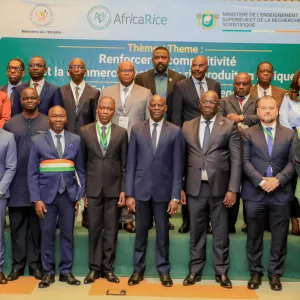
Held under the theme “Enhancing the Competitiveness and Marketability of Rice Produced in Africa,” the session was three days that produced a new continental membership, a new leadership mandate, an adopted institutional strategy, and four resolutions designed to accelerate Africa’s rice transformation.
“The AfricaRice Association remains strong because its Member States firmly believe that we must move forward together to achieve sustainable rice self-sufficiency,” explained Dr. Baboucarr Manneh, AfricaRice Director General.
SETTING THE STAGE
The session opened with a call that has defined AfricaRice’s mission for more than five decades: Africa’s rice self-sufficiency requires competitive, market-preferred locally produced rice — a message that made the chosen theme, “Enhancing the Competitiveness and Marketability of Rice Produced in Africa,” feel both timely and urgent. With the continent still heavily reliant on imports, the stakes of the discussions ahead could not have been higher. The Council convened under the chairmanship of the Democratic Republic of Congo, represented by Her Excellency Professor Marie-Thérèse Sombo, Minister of Higher Education, Scientific Research and Innovation — and was warmly hosted by Côte d’Ivoire, with particular acknowledgements to President Alassane Ouattara and Professor Adama Diawara, Minister of Higher Education and Scientific Research.
The Council reviewed a comprehensive biennial report from AfricaRice Director General Dr. Baboucarr Manneh, covering progress and performance across all programme areas from December 2024 to October 2026, as well as the recommendations of the National Experts Committee (NEC), constituted by the Directors General of national agricultural research institutions from member states.
DAY 2: SCIENCE AND INNOVATION ON DISPLAY
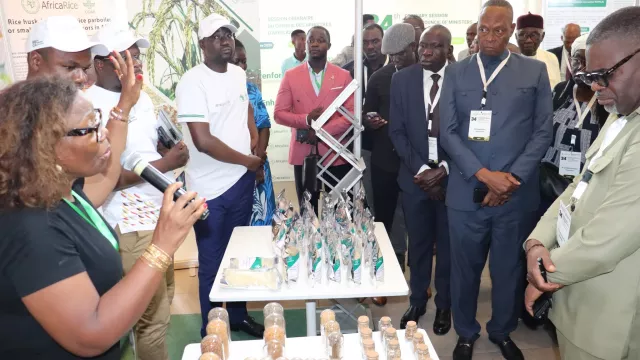
If Day 1 set the political and institutional stage, Day 2 put the spotlight where it belongs: on the innovators, entrepreneurs and researchers driving rice transformation across Africa. The Rice Day Exhibition showcased the science, the solutions and the people working at the frontier of Africa’s rice future, with recognition for the achievements of the Democratic Republic of Congo and Côte d’Ivoire — two countries whose rice sectors have been shaped in part by decades of AfricaRice partnership. Exhibitors presented technologies, varieties, processing solutions and market models that brought to life what rice research means for farmers on the ground.
CELEBRATING EXCELLENCE — THE COM34 AWARDS
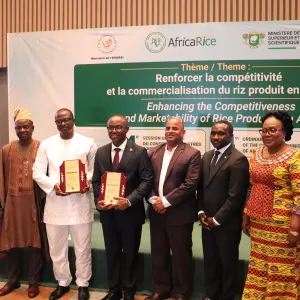
The COM Award of Excellence in Rice Research and Development recognized two outstanding laureates selected through a rigorous process evaluated by high-level external reviewers. The first is Prof. Maxwell Darko Asante, Director and Chief Research Scientist at CSIR-Crops Research Institute, Ghana — a breeder who has dedicated more than two decades to developing rice varieties that respond to the real needs of farmers and consumers. His work has led to the release of over 20 rice varieties now grown on more than 90% of Ghana’s rice area, with certified seed production exceeding 5,000 metric tons in 2025–2026, covering planting capacity of around 65,700 hectares. His publication record of over 100 research documents and an h-index of 19 reflects a career of genuine scientific depth.
The second laureate is a team represented by Dr. Ali Ibrahim, System Agronomist at AfricaRice’s St. Louis Station in Senegal, recognized for the development and scaling of RiceAdvice — a suite of digital tools that deliver site-specific nutrient management recommendations tailored to individual farmers’ conditions and ecologies. Built on continental-scale agronomy research conducted through the AfricaRice Agronomy Task Force, RiceAdvice and its lighter companion tool RiceAdvice Lite have reached over 70,000 farmers across Africa, delivering yield increases of 10 to 30% and income gains of 25 to 70% — without increasing fertiliser use. Available free on Google Play in English, French and Kiswahili, the tools represent exactly the kind of science-to-impact pathway AfricaRice was built to deliver.
SUDAN JOINS THE AFRICARICE FAMILY
One of the most anticipated moments of the session was the approval of the Republic of Sudan’s application for membership of AfricaRice. With Sudan’s accession, AfricaRice now counts 29 member states — a reflection of the growing recognition across the continent that rice research, anchored in a shared institutional framework, is a prerequisite for food sovereignty. Sudan brings its own agro-ecological context and rice production potential to the network, and its membership opens new avenues for AfricaRice engagement in the Nile Valley and broader East Africa region.
SIERRA LEONE TAKES THE CHAIR
The Council also confirmed Sierra Leone as the member state that will chair the AfricaRice Council of Ministers for the two-year period from 2026 to 2028. The handover from the Democratic Republic of Congo to Sierra Leone marks a geographic shift of the chairmanship to West Africa, and signals continued high-level political engagement from member states in the governance of the Center.
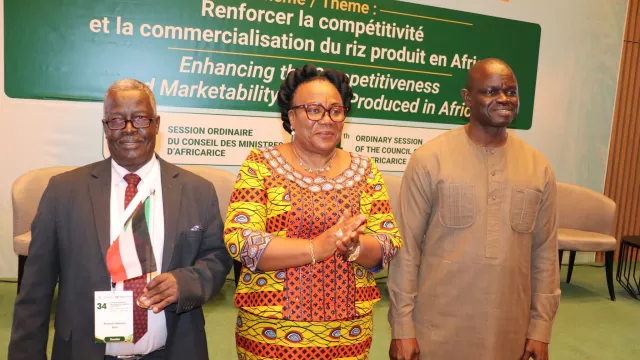
Beyond the symbolic moments, the 34th session produced four concrete resolutions. The Council adopted the AfricaRice Institutional Strategy 2027–2035 — a ten-year roadmap that will guide the Center’s research agenda, resource mobilization and partnerships through the next decade. It also resolved that each member state designate a national AfricaRice focal point, ensuring that innovations developed by the Center can be efficiently channeled to national research systems and farmers.