

EU-Funded Seeds4Liberia Showcases Innovation at the National Agriculture Fair
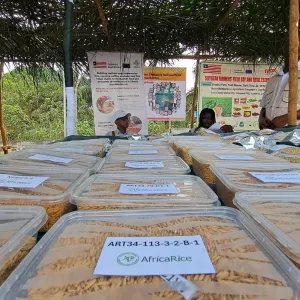
The EU-funded Seeds4Liberia Project participated in the recent national agriculture fair organized by the Ministry of Agriculture, showcasing research work on rice, cassava, coffee, soybean, and fish. The event, under the theme “Empowering Farmers, Enriching Nation,” celebrated the resilience of Liberian farmers, promoted local production, and strengthened national efforts toward self-sufficiency and sustainable agricultural growth.
The event was also a platform for networking and collaboration among project implementing partners – AfricaRice, the International Institute of Tropical Agriculture, and WorldFish.
The EU-funded Seeds4Liberia project, in partnership with the Liberian government, is a crucial initiative to strengthen Liberia’s seed systems. It does this through demand-driven, structured, and regulated seed systems across five value chains: rice, cassava, coffee, and fish. Africa Rice Center leads the project in partnership with IITA, WorldFish, along with the Ministry of Agriculture (MoA), the Central Agricultural Research Institute (CARI), the National Fisheries and Aquaculture Authority (NaFAA), the Seed Development and Certification Agency (SDCA), and the Liberia Agricultural Commodity Regulatory Authority (LACRA), supporting national development frameworks such as the National Agriculture Development Plan.
Proxy for Ambassador Nona Deprez, Head of the European Union Delegation to Liberia, Mr. Gilles Matayron, echoed the EU’s support to Liberia’s agricultural-food system through investment, collaboration, and advocacy for sustainability, inclusiveness, and resilience.
“Your Excellency President Joseph Nyuma Boakai, the EU is aware of your interest in the dedication to agriculture as a driver of economic growth. We acknowledge your leadership in the sector, and we stand ready to support Liberia’s agri-food systems from farm to fork,” said Mr. Matayron. “We will continue to invest, to collaborate, and to advocate for sustainability, inclusiveness, and resilience. Let us walk together – government, partners, the private sector, and farmers – hand in hand towards better food and a better future for the people of Liberia, its farmers, and its future generations.

Representatives from the European Union also visited the EU-funded Seeds4Liberia booths (Photo Credit: George A. Harris, AfricaRice)
Earlier, President Boakai called Liberians to attention, urging them to embrace agriculture as a pillar of the nation’s future. “No nation can truly stand while depending on others to feed it. Liberia must believe in itself, invest in itself, and build its future with its own hands. A food-secure Liberia is a proud Liberia.”
He further emphasized the sector’s transition to mechanization, where major value chains are developed and access to markets is improved, while Liberia’s farming community grows stronger, translating into development indicators such as productivity, efficient use of land and water, and improved social and economic conditions.
Major outcomes at the fair included Liberia’s Agriculture Minister, Dr. J. Alexander Nuetah, and his Assistant Minister of Planning and Development, Francis Mulbah, who separately visited the Seeds4Liberia Project’s booths to learn about the project’s five value chains – rice, cassava, coffee, soybean, and fish.
Touring the project’s booths, Minister Nuetah emphasized the importance of the government's plan for the coffee sector and expressed interest in scaling up Liberica coffee through a partnership with the EU-funded Seeds4Liberia Project.
“The fact that we have launched coffee Liberica as a priority variety, we would want all of our future seed multiplication and distribution to be Liberica preference. Let’s work together to achieve this. Thank you for the great job,” said Minister Nuetah.
Similarly, Assistant Minister of Planning and Development at the Ministry of Agriculture, Francis Mulbah, emphasized the importance of soybean data for near-term decision-making.
“It is really encouraging to see that all these products on display are made from soybeans. This is interesting because soybeans are a promising alternative crop for Liberia’s agricultural sector. Data will be important for us at the Ministry. Please keep and share the data and other publications with us,” said Minister Mulbah.
As the fair concluded, stakeholders’ understanding of the EU-funded Seeds4Liberia Project interventions in Liberia was amplified. As Liberia aims for resilient seed systems, the EU-funded Seeds4Liberia initiative serves as a model of effective collaboration among research, policy, and grassroots engagement to improve farmers’ access to quality seeds, boost production, and strengthen livelihoods.