


EU-funded Seeds4Liberia project highlights second year achievements in recent steering committee meeting
Updated: Jul 13

The EU-funded Seeds4Liberia project, which aims to support national development frameworks by building resilient seed systems for rice, cassava, coffee, soybeans, and fish value chains, highlighted significant achievements, including progress in the seeds, seedlings, and fingerlings production and certification process, capacity strengthening for technicians, and infrastructure support to agri-institutions during its recently concluded steering committee meeting at the Ministry of Agriculture (MoA).
As part of the seed certification process, the project has completed the production of breeder and foundation seed for all five value chains, and recruitment of 25 private seed enterprises to produce certified seed for rice, cassava, coffee, soybean, and fish is ongoing. With guidance from the project’s experts, the recruited private seed companies will produce 300 MT of rice; 62,500 bundles of cassava; 500,000 coffee seedlings; 1,800 tons of soybeans; and 25 million tilapia and catfish fingerlings and other strains.
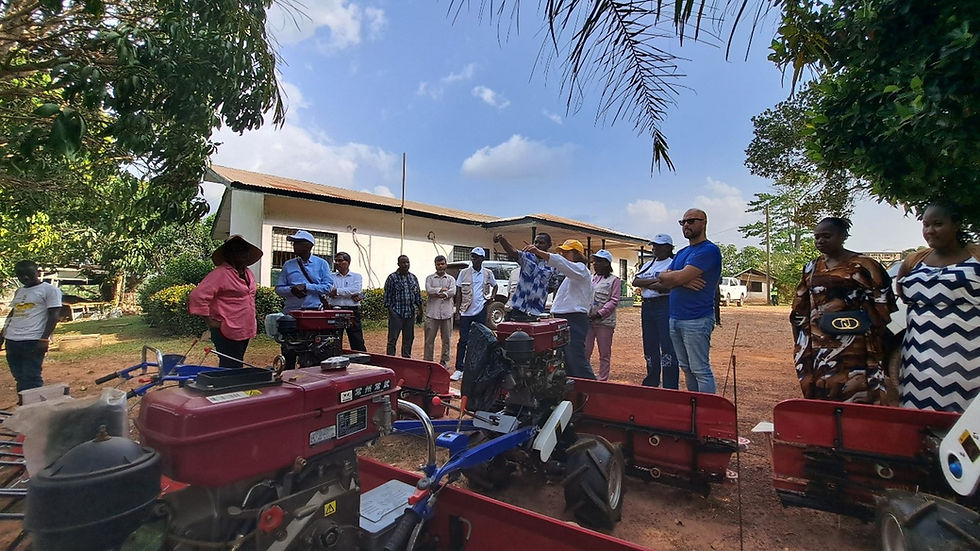
Additionally, the project plans to conduct several business management training sessions for the recruited private seed enterprises to make them investable by strengthening their systems and developing credible plans. Recruited private seed enterprises are also expected to receive low-cost maintenance agricultural machines to accelerate seed production.
Also, the project has directly trained more than 300 individuals from government institutions, community-based seed enterprises, and private seed companies across the project-focused value chain – rice, cassava, coffee, soybean, and fish.
Highlighting its support to agricultural infrastructure development, several accomplishments were noted. A seed storage facility, supervised by AfricaRice, is nearing completion at Central Agricultural Research Institute (CARI) as part of the EU-funded project’s infrastructure support for Liberia’s agricultural development frameworks. The cassava component of the project, led by the International Institute of Tropical Agriculture (IITA), installed the Semi-Autotrophic Hydroponics (SAH) Technology at CARI to accelerate the production of high-quality seeds. Similarly, the project’s fish component, led by WorldFish, has established hatcheries, ponds, and tanks at both CARI and NaFAA facilities – including indoor hatcheries with filtration systems, fry-nursing ponds, and circular and rectangular tanks. Moreover, a 3-hectare coffee germplasm conservation and mother garden has been established at CARI under the supervision of the IITA coffee team as part of the EU-funded project. Furthermore, soybean production, also led by IITA, has launched an adaptive trial to determine the ideal locations and planting times to achieve optimal soybean yields in Liberia.
In response to the project's activities and achievements, Agriculture Minister Dr. J. Alexander Nuetah applauded the project team for the milestones achieved and encouraged continued collaboration with Government institutions working alongside the project.
In the same vein, Antonio DI CLEMENTE of the European Union Delegation to Liberia also shared his impressions, noting that project implementation is on the right path. He reiterated the EU’s support for Liberia’s agricultural transformation and thanked the project implementing partners (IPs) for the progress achieved so far.
About the EU-funded Seeds4Liberia Project
The EU-funded Seeds4Liberia project, in partnership with the Liberian government, is a crucial initiative to boost Liberia’s seed systems, including soybean. It achieves this through demand-driven, structured, and regulated seed systems for soybeans and other key value chains, including rice, cassava, coffee, and fish. AfricaRice, the International Institute of Tropical Agriculture (IITA) and WorldFish, in collaboration with the
Ministry of Agriculture (MoA), the Central Agricultural Research Institute (CARI), the National Fisheries and Aquaculture Authority (NaFAA), Liberia Agricultural Commodity Regulatory Authority (LACRA) and the Seed Development and Certification Agency (SDCA) are implementing the EU-funded project.

Comments